
How to Check if a Casino Is UKGC Licensed, Using Lucki as the Worked Example
 Available in GB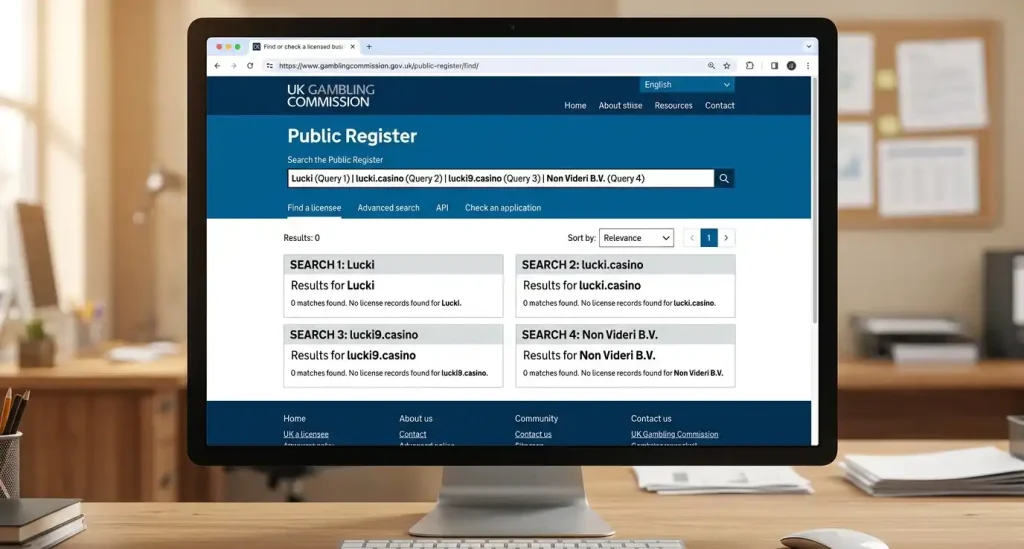
Lucki UK Guide editorial team · 9 June 2026
The UK Gambling Commission Public Register is the official source for confirming whether a gambling business is licensed to provide remote gambling to consumers in Great Britain. Affiliate badges, screenshot crops and “UK licensed” lines in third-party reviews are not substitutes – only a current register entry with the right operator identity, status and remote-gambling activities supports the claim. This page walks through the check as a UK searcher would run it, using Lucki Casino as the worked example. The same procedure works for any brand a British reader encounters in search results.
What the Public Register actually shows
The Gambling Commission maintains its register at the regulator’s official site. A successful business search returns the operator entity (the licensed company, not just a customer-facing brand), the trading names linked to that operator, the current status of the licence (active, surrendered, revoked or lapsed), the activities covered (for example remote casino, remote betting general, remote bingo) and, where applicable, the domains the operator has notified to the Commission. The combination of these fields is what establishes UKGC licensing for a particular brand on a particular activity in Great Britain.
The register is the public-facing surface of the underlying authorisation work the Commission carries out under the Gambling Act 2005. It is not a marketing tool, and it does not rank operators. It documents who is permitted to do what, and that is exactly the question a UK searcher needs answered before trusting any “UK licensed” claim. The supporting role this page plays inside the wider Lucki licence status review is to make the check itself easy to repeat.
Search terms to use for Lucki Casino
For a robust check, multiple search terms are needed rather than a single brand string. The set for Lucki Casino is: the brand name itself in both common forms (Lucki and Lucki Casino), the two known domains (lucki.casino and lucki9.casino), and the operator name reported by independent industry sources (Non Videri B.V.). Each term is searched separately, because the register matches against operator entities, trading names and notified domains in different fields. A brand might appear under an operator the search would not surface from a domain lookup, and vice versa.
At the time of writing, none of those four searches returns a verified match in the UKGC Public Register. The brand is not present as a trading name, the domains are not listed as notified URLs, and the operator name does not appear as a licensed entity. The combined reading from a fresh check is therefore consistent across search variants, which is the strongest form of a negative result.
What a valid match would need to contain
If a future check returned a register entry, three fields would have to line up before a UK-facing claim could be made. The operator entity returned by the search would need to be one of the names connected to the brand – Non Videri B.V. or any successor entity that brand materials clearly identify. The status would need to be active (a surrendered or revoked licence does not provide current coverage). The activities would need to include the relevant remote-gambling category for the product being offered – remote casino for casino games, remote betting general for sports betting, and so on. A licence for a different activity does not extend to one that is missing from the register entry.
Where domains are listed, they should match the URLs the brand is actually operating, including the redirect target (lucki9.casino in this case). A licensed brand can sometimes update its domain footprint and have older URLs unlisted, so the check is best run against the current operating domain rather than against historic addresses.
Signals that are not register matches
Several signals can look like register evidence and are not. A trust-mark or licence-logo image embedded in a casino site footer is a graphic, not a verifiable record; the Commission does not control where logos appear. A “UKGC-licensed” line in a third-party listicle is an editorial claim, not a primary source. A licence number quoted without a link to the register is a number; if the number does not return a match when entered into the register’s search field, it has no evidential weight. A jurisdiction reference such as “Curaçao” – which independent industry sources attach to Lucki Casino – describes a different regulator and is not relevant to the UKGC question at all.
The reverse is also true: the absence of a register match does not by itself prove anything about the brand’s wider reputation. It establishes one specific thing, which is the absence of UKGC authorisation. For UK consumer-protection purposes that is the controlling fact, but it is narrower than a general trust judgment.
Repeating the check independently
Running the check independently is straightforward and a useful habit when comparing any casino claim. Go to the Gambling Commission’s official site and find the Public Register business search; enter each of the search terms above in turn; for each result page, read the operator entity, trading names, status, activities and domains together rather than focusing on a single field. Keeping the brand and the operator separate during the search is the part most often skipped. A matching trading name without the right operator is not a match for a UK-facing claim made about that operator.
The same procedure applies to any casino a British searcher is comparing. Build the search-term set from the brand name, the known domains and the reported operator entity; run the four searches; compare the fields. If the result is a clean negative across all variants, the brand cannot be presented as UK-licensed regardless of any other signal.
Where the negative result leads
For Lucki Casino, the negative UKGC result connects with the broader picture in three immediate ways. It supports the conclusion of the Lucki Casino UK availability cluster page that the brand should not be treated as available to British residents under either the terms layer or the licensing layer. It feeds the structured non-branded path on the UKGC alternative checklist page, which sets out criteria for evaluating brands that do hold UKGC authorisation. And it positions the brand inside the wider regulatory framework explained on the UK gambling rules context hub, where licence requirements, advertising standards and safer-gambling duties for UKGC operators are described in detail.
How to Check if a Casino Is UKGC Licensed, Using Lucki as the Worked… — More on this topic at lucki casino.
See also Lucki Casino UK Availability.
Lucki Casino UKGC Licence and Trust Review for UK Searchers
Created by the "Lucki Casino" editorial team.